HSE Welfare Requirements for Construction Sites: A Complete Guide
When setting up a construction site, ensuring full compliance with the Health and Safety Executive (HSE) is not just about avoiding enforcement notices. It is about respecting the health, dignity and productivity of your workforce.
Under Schedule 2 of the Construction (Design and Management) Regulations 2015 (CDM 2015), contractors have a strict legal duty to provide suitable and sufficient welfare facilities before work starts on site.
At D-Tox, as portable sanitation experts, we know that welfare can feel like a complex puzzle. While our day-to-day speciality covers portable toilets, welfare servicing and waste management, we believe site managers need a clear, end-to-end understanding of all five core HSE requirements.
Here is a breakdown of what the law demands across every area of site welfare, and how to make sure your site stays compliant.
1. Sanitary Facilities (Toilets)
The Requirement
Sites must provide adequate, clean, well-lit and ventilated toilets. According to HSE and BS6465-1 guidance, the rule of thumb for standard portable toilet units serviced weekly is one toilet per seven workers, based on a standard 40-hour working week.
- Gender balance: facilities must accommodate both men and women. Single-occupant lockable cubicles are compliant for unisex use, but women's facilities must always include sanitary disposal bins.
- Maintenance: toilets must be maintained in a clean and fully working state throughout the build.
Where D-Tox Comes In
This is our core strength. Whether you need one portable toilet or a string of units for large crews, we provide fully equipped portable toilets with scheduled servicing covering waste removal, thorough cleaning and restocking of toilet paper, so you stay HSE-compliant from day one.
2. Washing Facilities
The Requirement
Washing facilities must be located next to sanitary areas and rest places. The HSE states these must include:
- Clean hot or warm running water where practicable.
- Sinks large enough to wash hands, forearms and faces.
- Soap or proper cleaning agents.
- Means of drying hands such as paper towels or hand dryers.
- Showers for particularly dirty work or handling hazardous substances such as lead, cement or asbestos.
Where D-Tox Comes In
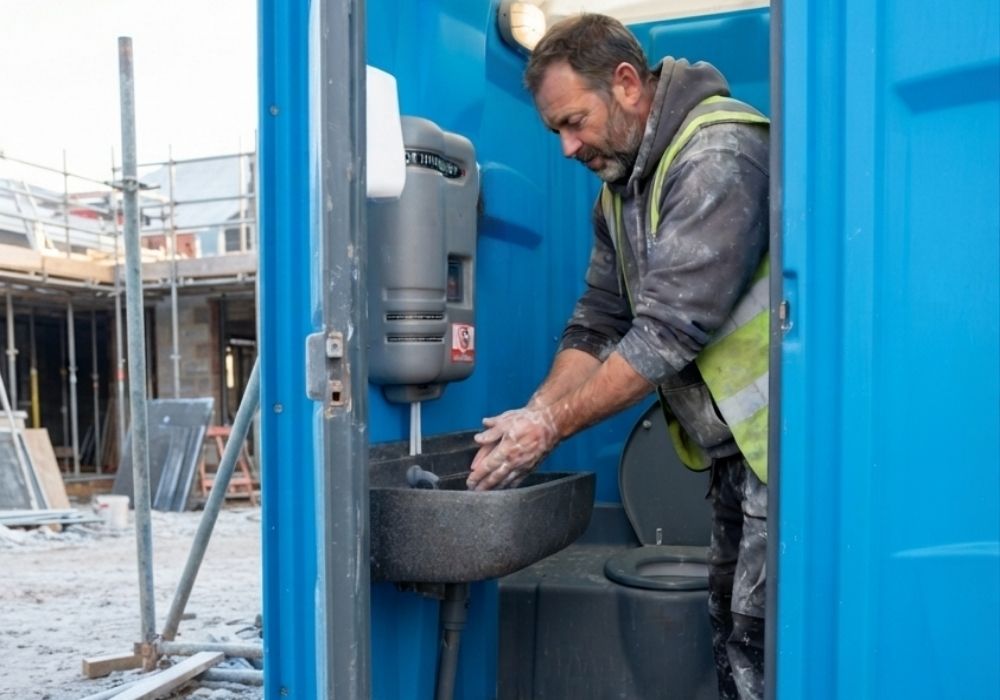
We supply self-contained hot wash portable toilets and portable handwash stations featuring foot-pump operation, making it straightforward to keep your team clean even on remote groundworks sites without mains water connections.
3. Rest Facilities and Canteen Areas
The Requirement
Workers need a sheltered, heated space to take breaks, protect themselves from the elements and eat meals safely. HSE regulations specify that rest areas must include:
- Tables and comfortable seating with back support.
- Means to boil water and heat food.
- Suitable heating and ventilation.
- Facilities for pregnant or nursing workers to rest lying down if required.
Where D-Tox Comes In
D-Tox does not supply welfare cabin structures or canteen appliances. However, rest areas cannot function legally or hygienically without proper waste management nearby. Having handwashing stations and toilet units positioned within easy walking distance of the canteen encourages site hygiene and prevents ground dirt or hazardous site residues from contaminating eating areas.
4. Changing Rooms, Lockers and Drying Space
The Requirement
If site workers need to change into specialist PPE or protective workwear, changing facilities are mandatory. The HSE requires:
- Private changing spaces, separated by gender where necessary.
- Lockers or secure storage for personal belongings and non-site clothing.
- Heated, well-ventilated drying rooms or racks to dry wet work gear.
Where D-Tox Comes In
Drying rooms and changing areas accumulate dampness, mud and odour quickly. D-Tox provides portable handwash sinks and effluent tank emptying services for mobile welfare units that house integrated changing rooms, helping to keep these spaces clean, fresh and compliant.
5. Drinking Water
The Requirement
Sites must provide a readily accessible supply of clean, wholesome drinking water. It must be clearly marked where necessary, suitable drinking vessels must be provided unless the source is a jet fountain, and it must be kept protected from contamination.
Where D-Tox Comes In
Potable drinking water and non-potable water supplies must be strictly separated from each other and from waste systems. D-Tox provides non-potable water delivery and bowser and tank refill services for site facilities such as toilet flushing, washing and construction use. Potable drinking water provision is the site manager's separate responsibility. For guidance on drinking water requirements, refer to the HSE's official CDM 2015 guidance.
Summary Checklist for Site Managers
- Adequate toilets provided before work starts, using one per seven workers as a starting point.
- Female sanitary bins provided in all facilities used by women.
- Handwashing facilities with warm water, soap and drying facilities adjacent to toilets.
- Rest area with seating, heating and means to heat food.
- Changing facilities and secure storage where PPE or specialist workwear is required.
- Drinking water supply clearly identified and protected from contamination.
- All facilities maintained in a clean and working condition throughout the build.
Frequently Asked Questions
What happens if a construction site fails an HSE welfare inspection?
If the HSE finds welfare facilities are inadequate, inspectors can take enforcement action, which in serious cases can include stopping work until the problem is fixed. That can cost valuable time and money in project delays.
Can male and female workers share the same portable toilet?
Yes. Under CDM 2015, single-occupant lockable cubicles are fully compliant for unisex use. However, if women are using them, sanitary disposal bins must be provided inside the cubicle.
What counts as a transient site for welfare requirements?
Transient sites are short-term projects or jobs where workers move between locations, such as roadworks. The welfare principles remain the same, but the HSE allows for more flexible solutions such as using local public facilities or mobile welfare vans, provided they are easily accessible and agreed in advance.
How often do site toilets need to be serviced to remain compliant?
The standard 1:7 calculation is based on units being professionally serviced at least once a week. If your site has high foot traffic, 24-hour shift patterns or more workers than the standard ratio allows, you will need to increase the frequency of your scheduled servicing.
Do we need showers on every construction site?
No. Showers are only required if your workforce is engaged in particularly dirty work or handling hazardous substances such as lead, contaminated land, cement dust or asbestos demolition.
Keep Your Site HSE-Compliant with D-Tox
Meeting HSE welfare standards under CDM 2015 is not optional. If basic hygiene and sanitation are lacking, inspectors can take enforcement action, including stopping work in serious cases. Whether you are planning a small short-term build or managing a major multi-stage site, getting your sanitation strategy right from day one saves time, protects your workers and avoids costly project delays.
Need expert guidance on site toilet ratios, servicing schedules or hot wash portable toilets? Call 0800 999 2260 or visit the D-Tox Construction Toilet Hire page.


